
Monk’s collections agent, Julia, can now place outbound collection calls and answer inbound AR questions from a dedicated business number, so finance teams can use the channel that collects best without adding headcount.
Multimedia: Watch Voice Collections in action: https://youtu.be/w09PoN1yACE
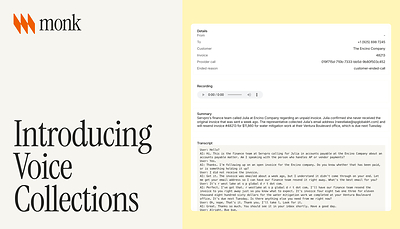
NEW YORK, July 23, 2026 /PRNewswire/ — Monk, the AI-native accounts receivable platform, today launched Voice Collections. Its collections agent, Julia, can now place outbound collection calls and answer inbound customer questions about invoices and payments from a dedicated phone number for each organization. The feature brings the phone, long the most effective collections channel and the hardest one to scale, into Monk’s Intelligent Collections.
Roughly $10 trillion sits in unpaid invoices worldwide, and the average invoice now takes 59 days to clear (Allianz). Most accounts receivable runs on email, and most of it waits. More than half of B2B invoices in the United States are overdue at any given time, and 92% of businesses are typically paid after their due date (Chaser, 2026). Phone calls recover overdue invoices two to three times better than email (Dunwise), yet 91% of finance teams still rely on email as their main follow-up channel and only 56% use the phone, because calling every overdue account by hand does not scale and a single human dunning call can cost $12 to $18 (HighRadius).
Voice Collections gives teams that coverage. Julia can call on the accounts a playbook flags for phone follow-up, and answer when a customer calls the same number back to ask about an invoice, a payment, or a bank detail. Businesses that follow up on 100% of overdue invoices are 76% more likely to be paid within a week (Chaser), and a voice agent is what makes full coverage possible.
Monk’s collections agent is already proven on the accounts it handles by email. Across Monk’s first 100 customers, Julia reaches customers with a 24% higher response rate than standard dunning and resolves 88.2% of collections with zero human intervention. Voice extends that reach to the phone.
“For years the assumption was that customers would not talk to an AI on the phone,” said George Kurdin, Founder and CEO of Monk. “The evidence now points the other way. People engage with a good voice agent, and in AR the phone was always the channel that collected best. We built Voice Collections so finance teams can finally use it at the scale email gave them.”
That assumption is worth retiring. In a University of Chicago Booth field study of roughly 70,000 interviews, people interviewed by a voice AI agent were 12% more likely to receive an offer, 18% more likely to start, and 17% more likely to still be there after 30 days, and 80% chose the voice AI over a human when given the choice. The setting was recruiting rather than collections, but the finding travels: given a capable voice agent, people lean in rather than hang up. A call also does something email cannot, which is secure a verbal promise to pay in the moment.
Built for finance, with the phone agents kept with strict guardrails
Voice in finance has to be constrained, and Monk designed Voice Collections around that from the start. The agent is read-only on the phone. It answers questions, confirms details, and routes the next step. It will not rewrite an invoice, change a payment status, or accept a sensitive payment change by voice.
The agent is also reference-based. If a caller asks about an invoice, Julia asks for both the company name and the invoice number before looking anything up, and it will not search broadly from a single detail. Every inbound and outbound call is kept in the collection record alongside the email history, so a callback is part of the same thread the team already sees, and anything that needs judgment escalates to a person.
“Voice in finance has to be careful by design,” said Joe Zhou, Co-Founder and CTO of Monk. “Julia will not browse across accounts or move money over the phone. A caller has to bring the company name and invoice number before it confirms anything, and every call lands in the record. In finance a 1% mistake is still unacceptable, so we built for that first and added the reach second.”
Teams run autonomous collections on Monk
Monk runs collections for finance teams at companies like Unify, Pump, Siro, and Elate, and Voice Collections extends what those teams already do by email onto the phone.
“We chose Monk to help automate our collections, a process previously demanding several hours a week of manual, one-off outreach,” said Will Stewart, Head of Finance and BizOps at Unify. “Today, our Monk agent is always running in the background and I have a single dashboard to manage AR from.”
At Pump, which manages volume across more than 1,500 customers, Monk has helped collect over $10 million in recent months.
Voice AI is now infrastructure
The timing reflects how far voice AI has come. It has moved from demo to infrastructure: Vapi has processed more than 1 billion calls, Bland handles over 3.5 million calls a week, and ElevenLabs raised a $500 million round at an $11 billion valuation in early 2026. Monk builds Voice Collections on that foundation and adds the part finance actually needs, which is the AR context, the controls, and the audit trail.
Voice Collections is available now as an opt-in feature. Monk configures the dedicated number and call behavior with each organization before turning it on in Collections. See it in action: https://youtu.be/w09PoN1yACE.
About Monk
Monk is the AI-native accounts receivable platform that helps finance teams turn revenue into cash. Its agent, Julia, runs collections, cash application, and forecasting as one connected system. Monk resolves 88.2% of collections with zero human intervention, reaches customers with a 24% higher response rate than standard dunning, reduces DSO by more than 40%, automatically matches 80% of incoming payments with a full audit trail, and gives finance teams back roughly 26 hours a month. Teams onboard in under a week and see results in their first month. More than $1.5 billion in receivables is managed on the platform, including for customers like Profound and ElevenLabs. Monk has raised $25 million and is based in New York.
Media contact
Kendall Warson
[email protected]
+1 415-827-6585
Sources: Chaser 2026 Accounts Receivable research; Dunwise dunning research; HighRadius collection call cost analysis; University of Chicago Booth field study on AI in recruiting; voice AI figures compiled by Enterprise DNA; Federal Reserve data; Allianz Worldwide DSO survey.

 View original content to download multimedia:https://www.prnewswire.com/news-releases/monk-launches-voice-collections-bringing-ai-phone-calls-and-callbacks-to-accounts-receivable-302833768.html
SOURCE Monk
